


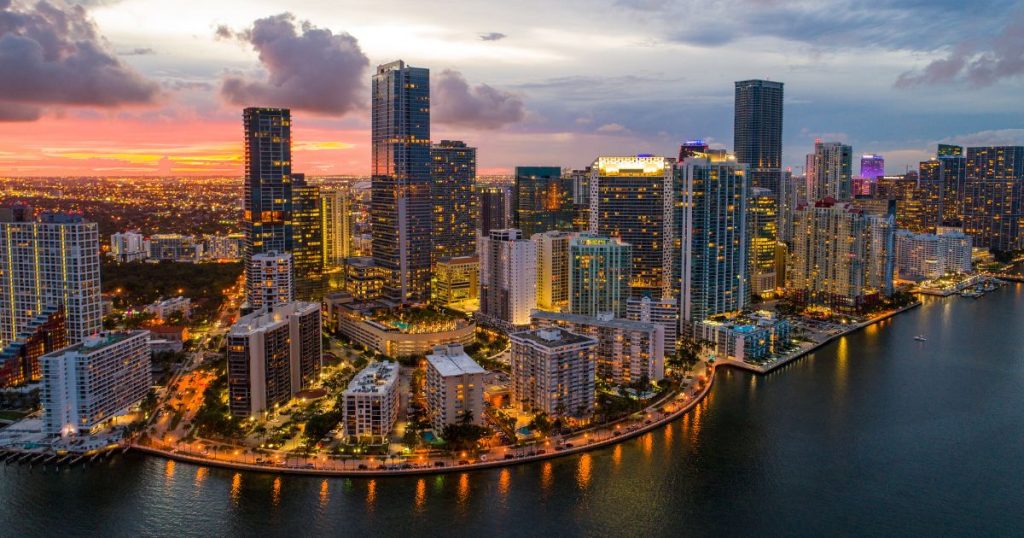
The rise of Waldorf Astoria Residences Miami is redefining the city’s skyline and ushering in a new era for luxury real estate, after years in which Panorama Tower stood as Miami’s undisputed height limit.
Over the past decade, Miami has experienced sustained vertical growth that reshaped its urban profile and accompanied the expansion of its luxury real estate market. Yet for many years, that growth had a clear ceiling when it came to height.
Towers became taller, more sophisticated, and more prominent—but without crossing into the exclusive category of super-tall buildings.
That landscape is now beginning to change. A new generation of projects is pushing beyond long-standing limits, repositioning Miami on the global map of large-scale residential architecture.
Panorama Tower: Miami’s Historic Height Benchmark
Before the arrival of super-tall towers, Panorama Tower set the city’s definitive benchmark. With 85 stories and a height of approximately 265 meters (869 feet), it became the tallest building in Miami and in the entire state of Florida, surpassing landmarks such as the Four Seasons Hotel Miami and dominating Downtown’s skyline for several years.
According to Grokipedia, the development combined luxury residences, hotel rooms, office space, and retail—a model that reflected a phase in which verticality was closely tied to mixed-use projects and gradual densification, rather than extreme height.
At the time, Panorama Tower symbolized the maximum scale Miami could realistically achieve, both from a technical standpoint and in terms of market demand.
The Waldorf Astoria Residences Miami: A Clear Break in Scale
The emergence of Waldorf Astoria Residences Miami marks a decisive shift. With 100 planned stories and a projected height of nearly 320 meters (over 1,050 feet), the tower will not only surpass Panorama Tower by a wide margin but will also place Miami firmly within the category of super-tall residential skyscrapers.
According to Infobae, the project—developed by Property Markets Group in partnership with the iconic Waldorf Astoria brand—combines ultra-luxury residences with high-end hospitality in a striking tower composed of stacked volumes designed to become a new urban icon. Beyond its architectural expression, the project reflects an ambition previously unseen in the city.
This leap is also rooted in broader economic and social conditions. Sustained inflows of international capital, growing interest from high-net-worth buyers, and Florida’s favorable tax environment have created the foundation needed to support developments of this scale. In that sense, Waldorf Astoria Residences Miami is not an isolated case, but rather the first visible sign of a new phase.
From Mixed-Use Verticality to Extreme Residential Luxury
One of the key differences between Panorama Tower and the new generation of super-tall projects lies in product focus. While Miami’s former tallest building relied on a diversified mixed-use program, today’s emerging towers place luxury residential living at the center of the concept.
Living at extreme heights is increasingly marketed as an experience defined by privacy, unobstructed views, and highly personalized services. Super-tall residential towers are no longer just an urban solution—they are aspirational assets aimed at an international audience seeking exclusivity, security, and long-term value preservation.
A New Skyline for a Global City
The contrast between Panorama Tower and Waldorf Astoria Residences Miami illustrates the pace of Miami’s transformation. In just a few years, the city has moved from celebrating its tallest building to planning towers that fundamentally redefine its historic limits.
This evolution directly impacts Miami’s visual identity, but it also strengthens its positioning within the global luxury real estate market. Height becomes a strategic tool—one that allows the city to compete with other elite urban centers and attract long-term investment.
The transition from the “before,” represented by Panorama Tower, to the “after,” embodied by Waldorf Astoria Residences Miami, reflects a city in the midst of reinvention. Miami is no longer satisfied with growing—it aims to stand out and claim a leading role among the world’s great urban destinations.
A skyline that once had a clear ceiling is now giving way to greater ambitions. The arrival of super-tall residential towers marks the beginning of a new era, where height becomes a symbol of the city’s evolving identity and global aspirations.
As Miami redefines its horizon and raises the bar for residential luxury, understanding which projects are setting the pace becomes essential. At Swann, we closely follow the evolution of the premium real estate market and the developments that anticipate the city’s next urban leap.
Explore more insights, opportunities, and residences shaping Miami’s new skyline with Swann.