


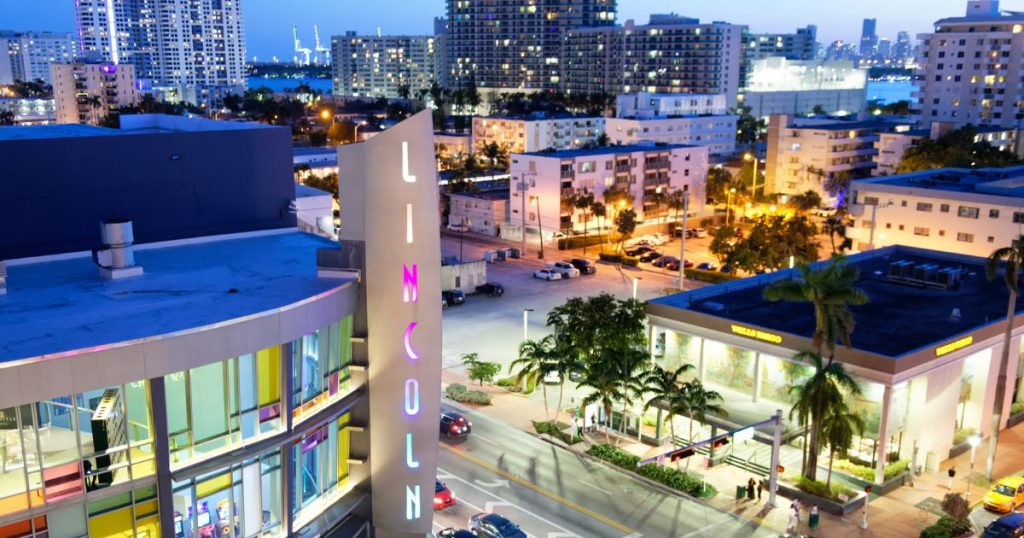
The iconic pedestrian promenade of South Beach is at a turning point. New private investment and an ambitious public redevelopment plan aim to restore Lincoln Road’s commercial, cultural, and urban prominence.
For decades, Lincoln Road was far more than a shopping street. It functioned as a social hub, an urban promenade, and one of Miami Beach’s most recognizable landmarks.
After years marked by rising rents, high tenant turnover, and competition from emerging districts, the corridor now appears to be entering a new chapter.
In recent months, a combination of strategic private investments and a city-led modernization project has reignited the conversation around the future of one of South Florida’s most emblematic thoroughfares.
A Historic Promenade at the Core of Miami Beach’s Identity
Throughout the 20th century, Lincoln Road cemented its identity as a pedestrian corridor closely linked to leisure, dining, and retail. According to Key Biscayne Portal, for long-time Miami Beach residents and neighboring communities, it was synonymous with weekend strolls, social gatherings, and a direct connection to the beach after crossing Washington and Collins Avenue.
This positioning turned Lincoln Road into one of Florida’s most recognizable commercial streets, attracting millions of visitors annually—even during periods of reduced activity.
Even in challenging market conditions, the corridor managed to sustain high-performing businesses and retain strong symbolic value within the city’s urban fabric.
From Boom to Decline: Rising Rents and Loss of Commercial Diversity
Lincoln Road’s relative downturn began in the mid-2010s, when rental prices reached levels that became increasingly unsustainable for independent operators. In certain stretches, leases reportedly climbed to around US$350 per square meter, accelerating the departure of long-established retailers and iconic restaurants.
Vacancy rates increased, and consumer traffic gradually shifted toward newer commercial hubs such as Brickell City Centre, the Design District, and Miami Worldcenter.
Ownership fragmentation—more than 60 different property owners—and rigid storefront layouts further complicated the corridor’s ability to adapt to evolving urban and retail dynamics.
The Return of Private Capital and New Commercial Bets
Against this backdrop, the return of investor Michael Comras to Lincoln Road marked a significant inflection point. After selling an entire block of the promenade in 2014 for US$370 million, Comras re-entered the market by acquiring properties on the 700 block at substantially lower valuations—paying roughly 40 cents on the dollar compared to prices a decade ago.
This new cost basis created room to rethink leasing strategies and attract a more diverse tenant mix—an essential step in revitalizing the corridor.
In recent months, Key Biscayne Portal reported the confirmation of new openings, including a restaurant and cocktail bar by hospitality group Hwood, as well as an investment by wellness brand Alo, which plans to open a retail store alongside a private fitness concept. These additions join other operators that have taken advantage of more flexible conditions to establish a presence on Lincoln Road.
Public Investment and a Major Urban Redesign
Alongside private capital, the City of Miami Beach has launched a comprehensive modernization plan for Lincoln Road, with an investment of approximately US$29.4 million. Construction began in September 2025 and focuses on transforming Drexel Avenue into a fully pedestrian corridor between Lincoln Lane South and Lincoln Lane North, according to Infobae.
The project includes upgrades to paving, lighting, landscaping, green areas, and street furniture, as well as expanded outdoor spaces for restaurants and cafés. A central feature of the redesign is the construction of an open-air amphitheater intended to host cultural programming and public events year-round. The project was designed by Field Operations and is being executed by Buslam Company Partners Inc.
A Medium-Term Revitalization with Long-Term Implications
Local authorities estimate that the main construction phase will last approximately one year, with completion expected in the second half of 2026. During this period, businesses will remain open, and alternative pedestrian routes will be implemented to minimize disruption to daily activity.
Meanwhile, the Lincoln Road Business Improvement District believes that the combination of public investment, renewed private interest, and more flexible leasing strategies could lay the groundwork for a sustained recovery. Market analysts agree that the key challenge will be balancing the arrival of global brands with the return of independent concepts that historically shaped the promenade’s identity.
After more than a decade of transformation, Lincoln Road is once again at the center of Miami Beach’s urban conversation. How these investments and interventions ultimately converge will determine whether the corridor can reclaim its role as a regional commercial, cultural, and social destination.
At Swann, we closely follow the processes that reshape cities and redefine long-term value. Lincoln Road stands today as a clear example of how the intersection of private investment, urban planning, and culture can reactivate an iconic public space.
Explore more stories on evolving destinations, real estate trends, and projects shaping the future of global urban development at Swann.