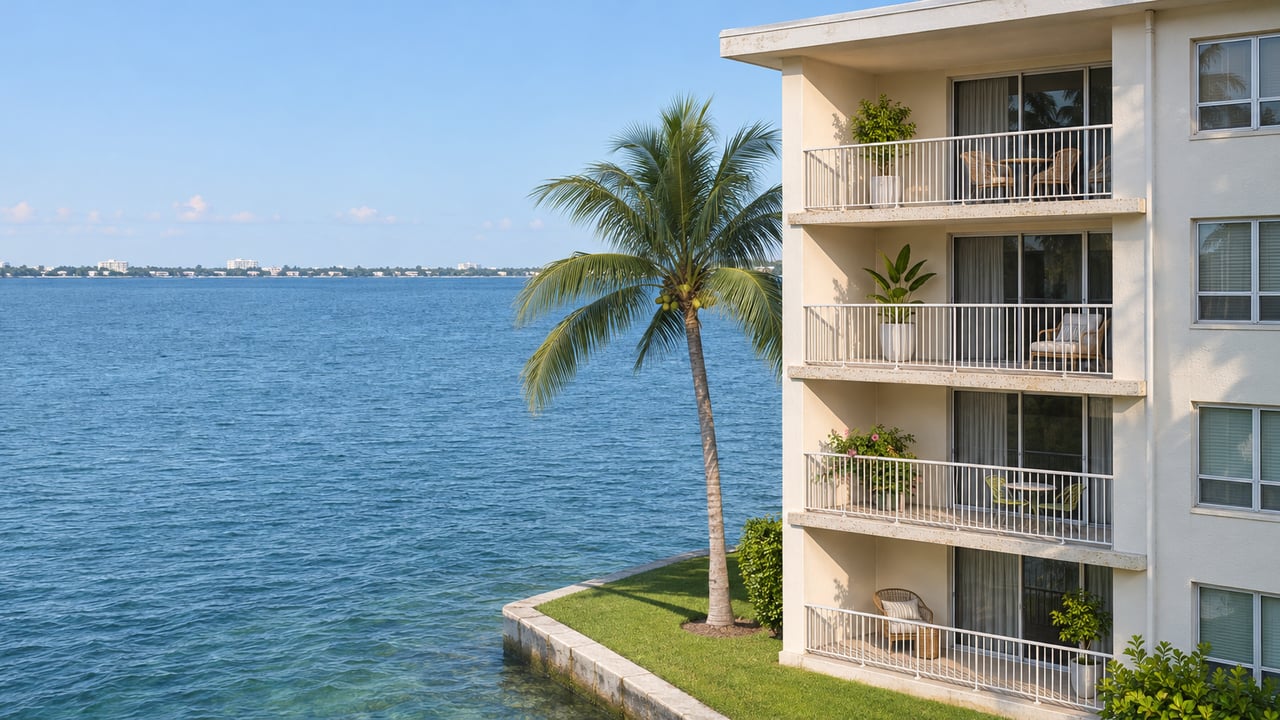
"I like to say 'I think we bought it twice.'" Taylor Collins, managing partner of Two Roads Development, said that at The Real Deal's Miami forum on November 5. He was describing Biscayne 21, the 1960s condominium at 2121 North Bayshore Drive in Edgewater that his firm spent four years trying to take down.
The building sits on some of the scarcest land in Miami. It has about 800 feet of bay frontage and is roughly 1,000 feet from Margaret Pace Park, according to the Biscayne Times. Most of what Two Roads paid to gain control of that land traces to four words missing from a condominium declaration recorded decades ago. In Edgewater's older bayfront buildings, that document now does more than the view to decide who gets bought out, at what price and how quickly anything new gets built.
The holdout math
In May 2022 a Two Roads affiliate paid about $150 million for most of Biscayne 21's units. The Real Deal put that at roughly $785,000 per unit. One owner who did not sell was an attorney. He told The Real Deal that in early 2021 he had asked for about a third more than the nearly $1.3 million he was offered, enough to cover a gut renovation and the cost of replacing a three-bedroom bay-view unit. He said he never got a response.
| Figure | Amount | Timing |
|---|---|---|
| Bulk purchase of most units | About $150 million, roughly $785,000 per unit | May 2022 |
| Offer to one holdout owner | Nearly $1.3 million | Early 2021 |
| Premium that owner says would have prevented the fight | $600,000 to $700,000 combined, for him and one neighbor | Early 2021 |
| Settlement paid to the holdouts | About $50 million, roughly $6.3 million per owner | August 31, 2026 |
The Real Deal's timeline arrives at the $6.3 million figure by treating the two couples among the ten holdout owners as one owner each. The apartments did not become more valuable as homes between 2021 and 2026. The developer had partially gutted the building, and it was uninhabitable for most of that period. The price rose because a court decided that each of those owners held a veto, and a veto is worth whatever it costs the developer to wait.
The phrase that gave each owner a veto
Florida's condominium statute lets a residential association adopt an optional termination plan with at least 80 percent of all voting interests. Under Section 718.117, the plan fails if 5 percent or more vote against it or object in writing. According to The Real Deal, that 5 percent rule is why developers try to control just over 95 percent of a building.
Biscayne 21's declaration set a higher bar. It required 100 percent of owners to approve a termination. After Two Roads bought its units in 2022, the board it controlled amended the declaration to the statute's 80 percent threshold. The declaration did not contain the words "as amended from time to time." Lawyers call this Kaufman language, after Kaufman v. Shere, a 1977 decision of the Third District Court of Appeal. A Florida Bar Journal article explains that a declaration with this wording takes in later changes to the Condominium Act, while one without it may remain governed by the law in force when it was recorded.
The appeals court held that, without that wording, lowering the threshold from 100 percent to 80 percent required every owner to agree. Glen Waldman, the Armstrong Teasdale attorney who represented the holdouts, told the Biscayne Times that the protection depends on the declaration. A threshold can still be lowered if the declaration allows it to be amended from time to time.
Developers have taken note. At the November 5 forum, Collins said, "We see a lot of Kaufman language absent [from buildings]. We tend to stay away from them." When the firm that just went through this case says it screens buildings for that phrase, the clause becomes part of an older building's value.
How long the clause kept the building standing
The cost of that ruling built up over a long timeline. When Two Roads bought the building, it planned to complete the first Edition Residences tower by the end of 2026. This is what happened instead, as reported by The Real Deal and the Biscayne Times:
- September 2022. Sales launched for a 55-story, 185-residence Edition tower designed by Arquitectonica, with prices starting at $1.7 million.
- May 2023. Ten owners sued to stop the termination. That summer the air conditioning failed, and the building was later declared uninhabitable.
- March 2024. The Third District Court of Appeal sided with the holdouts. It denied rehearing in July 2025, and the Florida Supreme Court declined to take the case in October 2025.
- January 2026. Miami-Dade Circuit Judge Thomas Rebull ordered the developer to restore the building. Cost estimates ranged from $60 million to $65 million.
- April 2026. Three buyers who had signed contracts for five Edition units in spring 2023 sued to recover their deposits. They argued the expected completion date of summer 2028 could no longer be met. Collins called the claims "without merit."
- August 31, 2026. The settlement with the holdouts was funded at about $50 million. Two Roads also took out an additional $46.86 million mortgage from Bank OZK on August 28.
Item five shows how far the clause reached. People who never owned a unit at Biscayne 21 signed contracts for a tower whose delivery date depended on how the old building's termination turned out. At the time of the August settlement, Collins told The Real Deal that presales had been slow, that he planned to reopen the sales center in October or November, and that demolition could begin within a few weeks. At the November forum, he said that in hindsight a partition sale, which he was told would take about 18 months, would have been the better route.
Farther north, a buyout that never closed
Bay Park Towers shows the same threshold blocking a deal in a different way. The building at 3301 NE Fifth Avenue dates to 1961 and has roughly 250 units. In 2021 it drew three bulk offers: $150 million from a group led by Vivian Dimond with Aman Group, $145 million from Bomel and $130 million from Beach Hill Capital, according to The Real Deal. By late September, Bomel and the Aman group were each at $150 million.
In October 2021 the Miami Herald reported a standoff. Dimond said her group had 43 contracts, Bomel was reported to have 130, and the 95 percent threshold meant neither side could take control. The Bay Park Towers Condominium Association continues to file annual reports with the state, including in 2026. At Biscayne 21, a handful of owners stopped one buyer. At Bay Park, two buyers split the owners between them. Both buildings were on the water, and in both cases the vote count decided the outcome more than the bid did.
Where Tallahassee stands heading into 2027
The rules that decided Biscayne 21 are still in force. The 2026 version of Section 718.117 keeps the 80 percent approval threshold and the 5 percent block. A 2026 bill, HB 657, would have required Kaufman language in new associations and given owners in existing ones a vote on adding it. It died in the Senate Rules Committee on March 13, 2026. In May, the Miami law firm Bilzin Sumberg described an effort to substantially revise the termination statute for the 2027 session. Collins put it this way at the forum: "the [state] law is just not written clearly yet." Waldman told the Biscayne Times that his firm hears from concerned condo owners at least once a week.
Reading an older Edgewater building the way a developer does
For a buyer comparing an older bayfront unit in Edgewater with a pre-construction residence, the declaration answers questions that a listing does not:
- Termination threshold. Does the declaration set its own threshold for ending the association, or does it rely on the statute? Biscayne 21's required 100 percent.
- Amendment wording. Does the declaration adopt the Condominium Act "as amended from time to time"? That language determines whether a later change in state law reaches the building.
- Bulk-owner protections. When a single bulk owner holds 80 percent or more of the voting interests, Section 718.117 adds conditional protections for everyone else. Non-bulk owners are to receive at least 100 percent of appraised fair market value. For a homesteaded owner-occupant who is current on association obligations, the floor is the original purchase price. Homesteaded owners receive a relocation payment of 1 percent of termination proceeds. If the former units are offered for public lease, an owner living in the unit when the plan is recorded may request a lease within 90 days and stay up to 12 months. If the bulk owner elects the board, non-bulk owners may elect at least one-third of it.
- Pre-construction on an assembled site. If the tower will replace an existing condominium, the old building's termination has to be finished before the new building's schedule means anything. At Biscayne 21, a certificate of termination was recorded in April 2026, three years after holdout owners first sued.
This is general information, not legal or financial advice. Questions about a specific declaration or purchase contract belong with a Florida condominium attorney.
Swann's founders have worked on land acquisition and developer-side sales, and they read a building's governing documents alongside its view and floor plan. If you are considering an older bayfront condominium in Edgewater or a tower planned on an assembled site, Swann Realty can review the termination clause, the amendment wording and the project timeline with you before you commit. Schedule a Consultation.